However high-ranking an individual might be, or however “full” the powers they might be entrusted with in the process of political transition in Syria, Syrian President Bashar al-Assad will remain in Russia’s opinion, president with full powers, as a “wartime president.” This could be an issue of disagreement or one of understanding in the relationship between the United States and Russia, which is being managed by both US State Secretary John Kerry and Russian Foreign Minister Sergey Lavrov, in the hope of paving the way for a successful summit between their two presidents, Barack Obama and Vladimir Putin, next month.
Their focus now is on holding an international conference that has become a priority of the utmost importance primarily for Russia. Moscow wishes very much, and adamantly so, for Iran to have a seat at the table of Geneva 2, an international conference that will include Saudi Arabia and other regional powers alongside the five permanent members of the US Security Council.
But Moscow is equally insistent on excluding Qatar from the issue of Syria, as a result of profound enmity between them due to their struggle over the issue of natural gas and that of the rise of Islamists from the Muslim Brotherhood to power. There is talk of Russian diplomacy having succeeded at convincing American diplomacy to agree to exclude Qatar’s leadership on the Syrian issue.
Russian diplomacy is behaving at this stage with the utmost confidence, and on the basis that the Syrian president will remain in power until the presidential elections one year from now. Russia is confident that the opposition in Syria will grow increasingly fragmented, that the rift within it will deepen, and that it is the opposition itself that will bring about its own defeat.
Proceeding from this, Russia considers it a near certainty that the regime in Damascus will survive, and considers it quite likely for Bashar al-Assad to remain president after the 2014 elections. Contributing most prominently to Russia’s increased rate of self-confidence and to the triumph of the alliance of defiance that includes it along with the regime in Damascus, the Islamic Republic of Iran and Hezbollah, in addition to China to a lesser extent – is the US administration itself.
This means in particular President Obama, whom President Putin views as either unwilling to confront the alliance of defiance, or unable to challenge such an alliance, which is determined to triumph over the United States through the war in Syria.
This extent of belligerence towards the West among Russia’s neo-nationalists –who have been gaining prominence in Russian policy-making over the past few years – is striking. Indeed, haughtiness, arrogance and pride have become the main features of Russian patriotism, taking the form of excessive nationalism and an insistence on achieving victory and the upper hand over the West, even if the means to achieve this is the rise of despotism and tyranny to combat the West (the term “West,” in Russia’s lexicon, means primarily the United States).
Indeed, Moscow still insists on regaining its role as one of the world’s two superpowers, and is determined to put an end to the unipolar era at any cost. One of the means to do so, in the view of extremist Russian nationalism, resides in supporting “religious renaissance” in all its forms and across the spectrum, as well as the growth of authoritarian and tyrannical regimes – both in response to the West.
The goal is to teach the United States a lesson and to place the West – here meaning the North Atlantic Alliance (NATO) – in a situation that would force it to defend itself by force of arms. Indeed, the battle is over Western values, and the goal is to bring them down by any means necessary.
This does not at all mean that the entirety of Russian thought can be painted in the same color. There is a whole spectrum of opinions on Russia’s relationship with the West, as there is on the issue of Russia’s priorities in the Middle East, as well as with regard to how to deal with Russia’s “no” to the rise of Islamists to power and to the means of dealing with the danger of Muslim extremism for Russia.
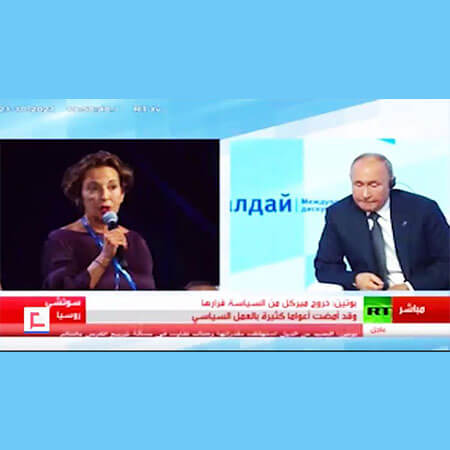
This week, the Valdai International Discussion Club held a conference in Marrakesh entitled “Islam in Politics: Ideology or Pragmatism?” The conference gathered prominent Russian and foreign experts to discuss this issue of great importance for Russia.
The club, which was formed nine years ago, established in 2009 a Middle East Dialogue division aimed at analyzing the region’s main issues and assessing the role played by Russia in the Middle East and North Africa, in addition to formulating recommendations and preparing strategies for the governments of the countries concerned. Members of the Valdai Club also hold meetings with Russia’s president, prime minister and foreign minister, as well as with many prominent figures of politics and society active in Russia.
The Marrakesh conference is noteworthy for many reasons, among them the title chosen by the Russian club for the discussion and the personalities participating, which included representatives from Hezbollah, Hamas, Egypt’s Jamaa Islamiya and Egypt’s al-Nour Party, alongside a number of modernists or secularists from the Arab region and experts from Iran and Central Asia.
Of course, the majority was made up of Russian experts, headed by the conference’s two organizers, Vitaly Naumkin, Director of the Institute of Oriental Studies, member of the Scientific Council of Russia’s National Security Council and President of the International Center for Strategic and Political Studies; and Pavel Andreev, Executive Director and Head for International Cooperation at Russian news agency RIA Novosti.
It was very striking to listen to Russian opinions during as well as on the sidelines of the sessions, as diverse, numerous and different as they were. The side calling for moderation with the West, rather than the automatic fanaticism against it that characterizes most of Russia’s foreign policies, seemed quite weak.
The opinion of the majority was characterized by patriotic national pride and insistence on Russia’s right to prevent the “trick” played by the West in Libya – in reference to the military action carried out there – from being repeated. As for the stance on the role played by Russia in Syria, it was identical across the spectrum of Russian opinions, being, in short, one of complete support for Russia’s role in its political, military and diplomatic aspects.
Some make sure to rush to say – as they did a few months ago through envoys to New York – that there is no great love lost between Russian diplomacy, as run by Vladimir Putin, and Bashar al-Assad, and that the issue concerns the alternative to the regime. Their opinion, in short, is that the Assad “obstacle” is not a Russian one, and that whether he stays or leaves is not Russia’s responsibility.
Yet upon close examination of Russia’s strategic position on Syria, it appears that its alliance with Iran and Hezbollah is a serious one, and one determined to achieve victory, as represented by maintaining the regime in Damascus.
Russia disagrees with Iran’s leadership and with Hezbollah on the issue of opening up the Golan for resistance against Israel. Moscow is opposed to opening the Golan front to resistance. It is opposed to it by principle, because its relationship with Israel remains a special one, and one that it does not wish to squander.
It is also opposed to reactivating the Golan front because....